
COMPARE THE FINISHES BEFORE COMPARING THE NUMBERS
Mould Inspection Acton
A tiled return, lined wall and exposed plaster can produce different moisture-check evidence in one room. For an Acton inspection, we identify those surfaces and choose meaningful comparisons before deciding that a change in readings reveals a hidden source.
- Keep each tested finish identifiable on the room plan
- Compare like materials where a suitable reference exists
- State what a lining prevents the accessible check from establishing
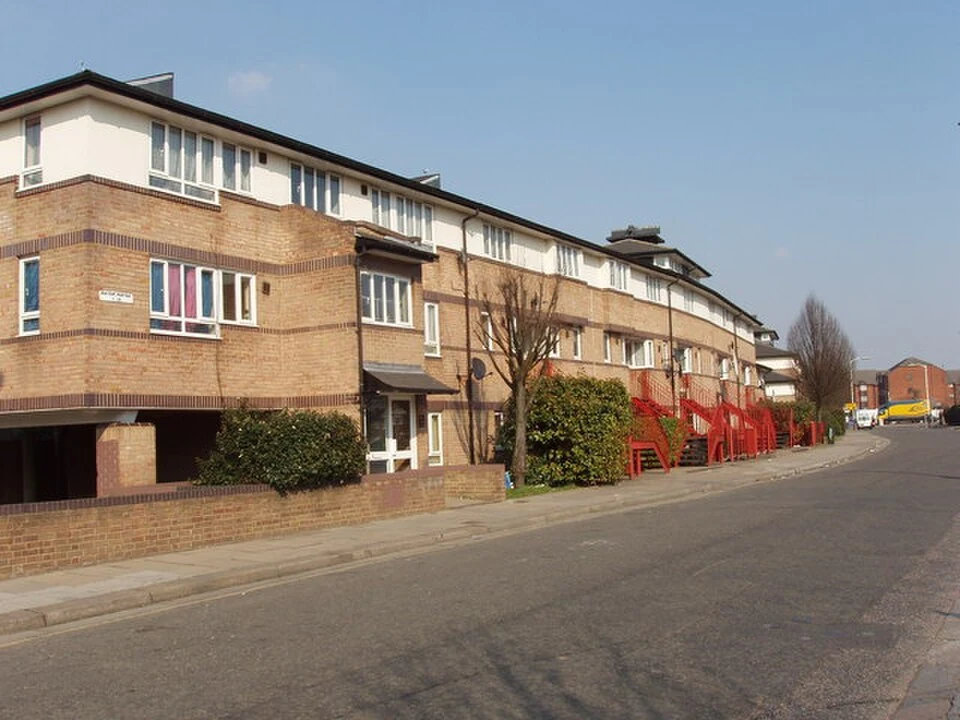
Property reference photograph; not a company job. Photo: David Hawgood · CC BY-SA 2.0 (resized WebP).
Draw the material boundaries first
Mark where paint changes to tile, a repaired patch meets older plaster or a lining covers part of the wall. Add the visible growth and any known previous wetting. This map prevents a response at one finish being treated as direct evidence of a difference in the wall behind another.
Our assessment of the wall material pattern considers those boundaries with the accessible condition. If the construction is unknown, record that uncertainty rather than giving the entire wall one assumed material label. A finish may have been added after the original building was completed or altered in only one part of a room.
Decide what makes a useful reference
A nearby clear surface can help only if the comparison is appropriate. Different material thickness, coverings and construction may affect what can be measured. A tile beside plaster is not automatically a dry control for the plaster, and a patch repaired after a leak may not be equivalent to an untouched part.
We consider the method and suitable comparison positions within the available scope. The aim is a meaningful pattern, not a large table of unlike results. If there is no adequate accessible reference, that limit should be explained rather than concealed behind a confident average for the room.
Bring photographs showing earlier openings or repair work if available. They can clarify material changes now hidden by decoration, but cannot establish the present moisture within every concealed layer. The record helps select a question to examine rather than substitute an old image for current evidence.
A response through a finish has limits
Some checks respond to properties of the material or nearby components as well as moisture. The instrument, mode and tested surface need context. We avoid converting a relative response into a direct water-content claim or using a difference across unlike finishes to name a leaking pipe.
Where a local pattern supports it, investigation of a possible concealed water route may be relevant. The supporting account should include the timing and layout, not only a number at a wall position. A result that cannot establish the source should remain a prompt for further enquiry, rather than be presented as the completed diagnosis.
Separate the exposed surface from the covered assembly
Visible growth on a lining and the condition of the wall behind it are different questions. An accessible surface can be affected while the underlying assembly remains unexamined. Equally, a clean face does not certify every hidden material. Describe the covering and any existing safe access before assuming that one side tells the whole story.
An authorised opening may be useful if a concealed material matters to the next decision. Ask which layer needs examination, what would be established and how the result would change the proposal. Removal and reinstatement require their own scope; the inspection should not default to stripping the room simply because material comparisons are imperfect.
Let room conditions provide another line of evidence
Condensation observations can help explain why one exposed surface receives growth without identifying the concealed wall’s state. Tell us where droplets occur and whether the patch changes during ordinary room use or wet weather. Those accounts should be considered with the material map rather than assigned to an assumed coating fault.
Our review of condensation influences can contribute to that enquiry. A surface-temperature difference or covered corner may warrant attention, but does not by itself specify insulation work. The recommendation should distinguish an observed surface condition from a construction detail that still needs confirmation.
Keep the Acton work record with the material map
Ealing’s Acton Green appraisal records red and stock brick alongside areas of roughcast and stucco within its boundary. Where an Acton room has original material and later finishes, identify the actual tested surface rather than infer its substrate from the elevation outside. A lined section, exposed plaster and tiled return may need different comparisons. The local material context supports asking what each result describes; it does not convert unlike readings into proof of a concealed moisture source.
Bring the descriptions of earlier plaster, lining or tile work. If information is absent, we can still discuss the accessible enquiry while noting what cannot be inferred. A neighbourhood name does not establish the substrate or justify a uniform measurement method for every wall.
Local building context: Ealing Council: Acton Green appraisal, section5.3 building materials.
Make the next material decision explicit
The findings should say which comparison was useful, which concealed question remains and whether another check is likely to change the response. Treatment of the affected finish should fit the material condition and supported moisture concern. Replacing a lining, drying a substrate and cleaning surface growth are different actions.
After work, preserve the map but update it for the new materials. A reading from replacement plaster is not automatically comparable with the old covering at the same position. Any review should account for that change and the relevant conditions, rather than treat a changed number as proof that every part of the concealed assembly is resolved.
Before another round of treatment
Can readings on tile and plaster be compared directly?
Not without considering the method, materials and purpose of the comparison. Their responses may differ for reasons other than a change in moisture. A useful record identifies the surface and explains whether the reference is suitable, rather than assuming adjacent materials provide equivalent measurements.
Why map an earlier repaired patch?
It can differ from the finish around it and may connect with earlier wetting or changed construction. That helps interpret a present comparison. The repair date and description provide context; they do not automatically establish that the same moisture route is active today.
Does a clean lining prove the wall behind it is dry?
The visible face does not establish every concealed material’s condition. The relevant question is what the accessible check can support and whether further examination would change the decision. Additional access should have a specific purpose rather than be assumed for every lined wall.
Should a sample of the covering be removed beforehand?
Do not open the finish merely to prepare for the visit. Describe it and provide existing repair information. If exposing a layer is recommended, the location, purpose, permission and reinstatement should be agreed before material is removed.
Can one result justify replacing all the plaster?
A single response should not dictate a whole-room specification without supporting material and moisture evidence. Ask which areas are affected and why removal is proposed. Suitable comparisons and any access limitations need to be clear before selecting disruptive work.
How should new materials be considered at follow-up?
Record what replaced the earlier finish and which positions are now tested. Changes in material or method can affect comparison. A review should interpret the new condition and supported source work, rather than assume old and new numbers measure identical assemblies.
Nearby areas we cover
Tell us where the wall finish changes.
For Acton, describe the coverings, repaired patches and positions with growth or unusual readings. Call to discuss comparisons that suit the material and any concealed question that remains.