
How to Compare Moisture Readings Over Time

A meter shows a high number beside a damp patch on Monday and a lower number two weeks later. Has the wall dried? Perhaps, but the comparison is only useful if the readings represent the same material, the same location and broadly comparable conditions. A few centimetres can place the instrument over a timber batten, metal fixing or different plaster. Paint, salts and surface temperature can also affect the response.
Repeat measurements are most valuable when they answer a specific question: Is an affected area changing after a repair? Does it respond to rain or water use? Is a suspect section different from a similar unaffected section? A short, consistent record can support those decisions. It cannot, by itself, identify every hidden source or certify that a concealed layer is dry.
Define the question before taking readings
Write one sentence about what you are trying to test. “Has the ceiling below the repaired bathroom waste fitting shown a downward trend during normal use?” is clearer than “check damp”. The question guides the locations and timing. If the concern follows rain, a reading just after an event and another during a dry spell may be relevant. If it follows plumbing use, record that use and the repair date.
Choose a small set of points: the centre and edge of the visible patch, a nearby area of the same material that appears unaffected, and perhaps a comparable wall elsewhere. Mark them on a photograph or simple sketch. Use a non-damaging reference method appropriate to the finish; do not drill or damage the surface to make a permanent mark. The exact point matters because building materials are rarely uniform.
If a surveyor is doing the monitoring, ask them to include a location key and instrument details in the report. A sheet of numbers with no map may be impossible to interpret later. The RICS and Historic England joint statement on moisture emphasises relating measurements to building context and using proportionate investigation.
Compare like with like
Plaster, timber, brick and tile do not share one universal meter scale. Even two areas of plaster can differ because one is skimmed over old masonry and the other is on plasterboard. A pin meter and a pinless meter respond to different properties and sample different zones. Keep the device, mode and placement consistent. Do not combine a number from one instrument with a number from another as if they were the same measurement.
Record the surface finish, whether it was painted or cleaned between visits and whether a new repair changed the material. A freshly skimmed patch and old dry plaster are not suitable direct controls. Metal corner bead, foil-backed board and hidden pipes can affect electrical readings. Salts left by past water movement can also complicate a response. Historic England’s guide to assessing damp discusses why the chosen method must suit the fabric.
For timber, a pin meter may offer a different type of information from its use on plaster, but the species, temperature and calibration matter. Do not copy a generic “safe” number from a product label to every building material. If the result will decide whether to replace structural or expensive fabric, use a competent assessment rather than relying on a home device alone.
Record the conditions around each measurement
Each entry should include date and time, exact point, instrument and mode, displayed reading and a brief note about conditions. Add whether the heating was running, whether the room was recently ventilated, whether rain occurred and whether relevant water services were used. If the surface was recently cleaned or painted, say so. These details may explain a change that would otherwise look like drying or new wetting.
A room can have comfortable air while an external wall remains cold. Condensation on the room-facing surface can change quickly with temperature and humidity. A reading immediately after a shower may not be comparable with one taken in a dry afternoon. You need not build a laboratory. Consistent timing and honest notes about differences are enough to make a short series more useful.
Photograph the patch at each visit from a repeatable position. The stain’s boundary, paint condition and mould pattern may change even where the meter display is ambiguous. Conversely, old discolouration may remain while the material dries. A photographic sequence and measurement series together are stronger than either alone. Our guide to recording a recurring damp patch provides a practical timeline format.
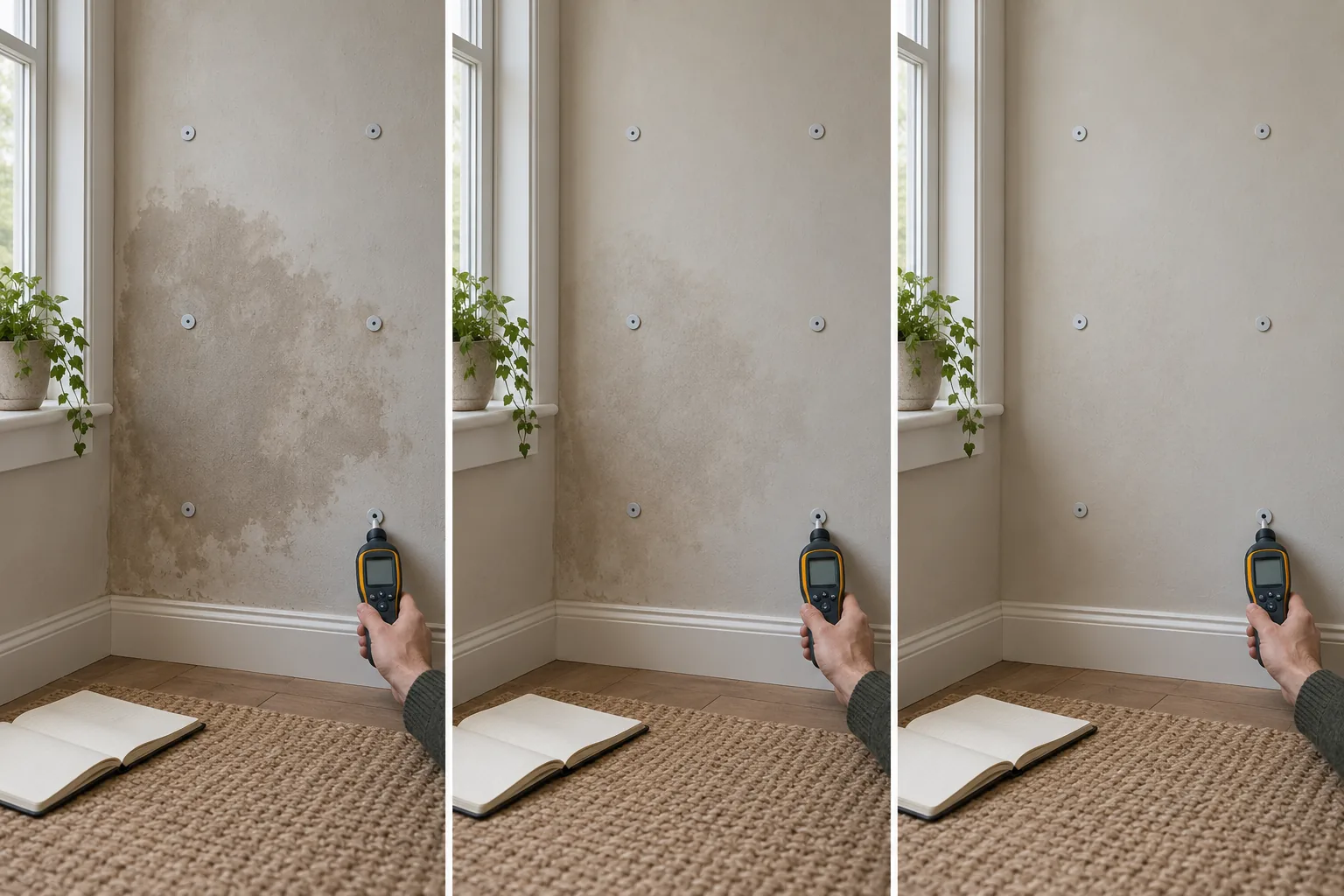
Look for a trend, not a magic threshold
Several consistent observations can be more informative than a single “high” or “low” display. If the affected point steadily approaches a comparable reference area after the source repair, that supports a drying interpretation. If it spikes after rain while the reference stays stable, a weather-related route deserves investigation. If all points move together, changes in room conditions or instrument use may explain part of the pattern.
Do not smooth away inconvenient readings. A sudden rise might be a real event, a wet cleaning session or a placement error. Note what changed and repeat at the same point when appropriate. If the instrument gives an arbitrary scale, report its numbers as that device’s response, not as a percentage of water in the wall. Our separate guide to what a moisture meter reading can really tell you explains why material-specific interpretation matters.
Trend language should match the evidence. “Readings at three marked plaster locations fell over four visits after the pipe repair” is useful. “The whole wall is completely dry” goes further than those measurements can establish. A report should state which areas were inaccessible and whether concealed layers could still be affected.
Use the repair date as a clear dividing line
When monitoring after a repair, put the date and scope of the work in the record. What was found, what was changed and what was left untested? A gutter clearing, pipe replacement and redecoration have different implications. If the repair addressed a plausible source, the follow-up should test the expectation linked to that source. For a roof fault, observations through relevant rain may be needed. For a bathroom leak, normal use after repair is the relevant comparison.
Drying can take time and depends on material, the amount of water and ventilation. Do not promise a fixed number of days. If a lining is damaged or mouldy, the question may be material condition as well as water content. A professional may recommend focused access to inspect a void rather than waiting indefinitely for a surface reading to change.
Do not postpone urgent action to gather a perfect series. Active leaking, a sagging ceiling or water near electrics calls for prompt safety and repair attention. Measurements are a tool for investigation and follow-up, not a reason to leave a hazard in place.
Decide when another test is needed
If readings remain high at the same points, rise repeatedly after relevant events or disagree with worsening visible damage, ask what explanation fits all the evidence. The answer may be an unrepaired defect, a second route, salts or a method limitation. A surveyor might inspect an accessible roof or plumbing detail, use a different measurement method or recommend a controlled opening. The next test should be chosen to discriminate between plausible causes.
If readings fall but odour or damage continues, do not assume everything is resolved. Concealed insulation, timber or plasterboard may need assessment. A non-invasive moisture inspection has limits, and a clear report should say when those limits matter. If the affected material has been replaced, start a new baseline rather than pretending the earlier numbers remain directly comparable.
For a London property with a recurring damp concern, a damp inspection can set up useful reference points and relate them to the building. Contact our team with the repair history, photographs and any existing readings. The goal is a well-supported next decision, not simply a lower number on the display.