
What a Moisture Meter Reading Can Really Tell You
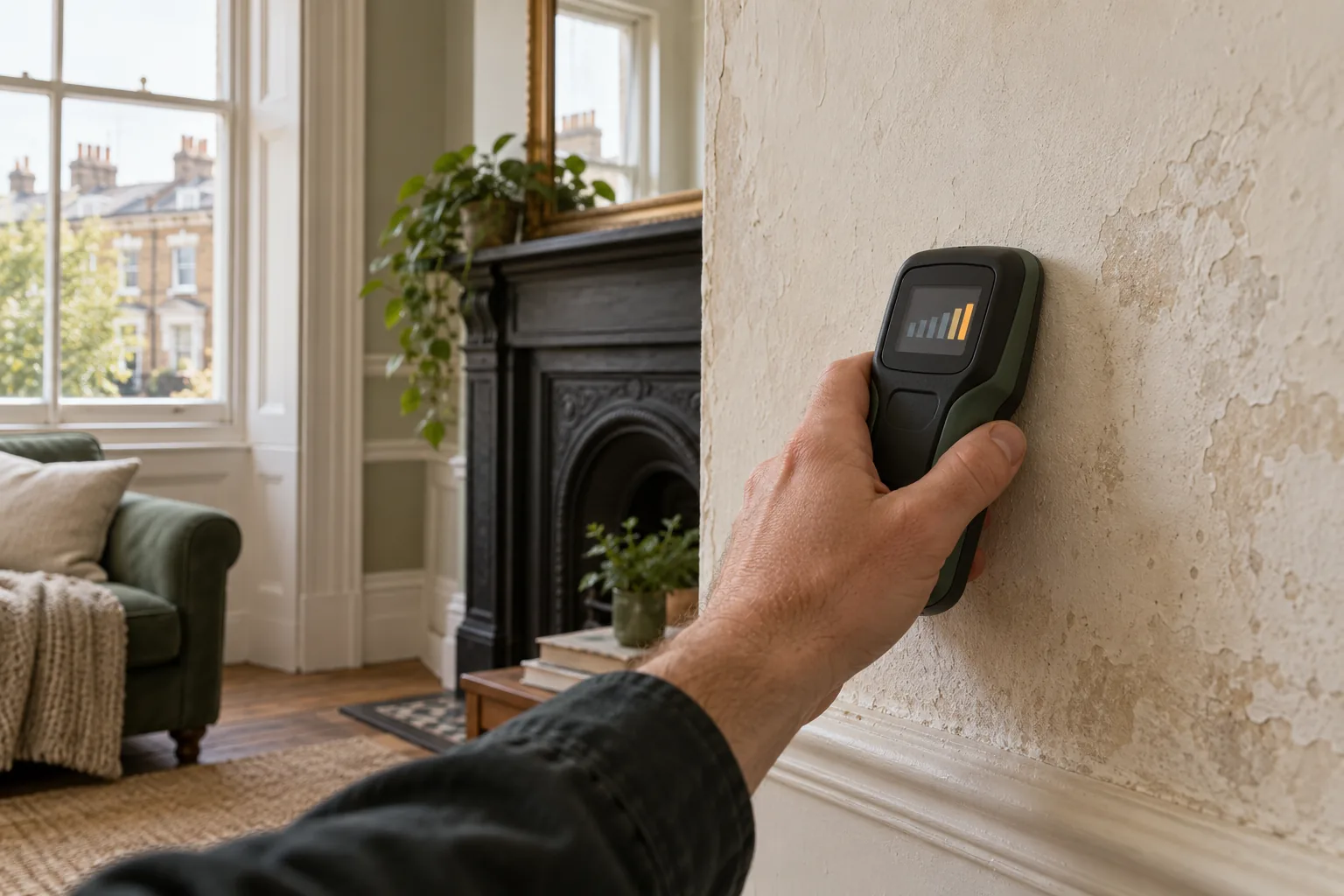
A surveyor touches a meter to a wall and the display rises. It is understandable to ask whether the wall is wet, where the water came from and what needs repairing. The number alone cannot answer all three questions. Its meaning depends on the instrument, the material beneath the probe, the surrounding conditions and the pattern across the room. A useful reading starts an investigation; it does not finish one.
This matters when a proposed repair is expensive or disruptive. A high indication on old plaster might justify further checks. It does not, by itself, establish that water is rising from the ground, that a pipe is leaking or that a chemical damp-proof course is needed. Equally, a low surface indication does not necessarily tell you what is happening behind a lining. Understanding what the meter actually responds to helps you ask better questions before authorising work.
First ask what type of meter was used
The term moisture meter covers several instruments. A two-pin resistance meter passes a small electrical current between its probes. Damp timber generally conducts differently from dry timber, so a correctly used instrument calibrated for wood can provide a useful estimate of timber moisture content. On plaster and masonry, the display is often an electrical indication or a reading expressed on a wood-based scale. It should not automatically be interpreted as a percentage of water in the wall.
Other handheld instruments are described as pinless, capacitance or radio-frequency meters. They sense changes in electrical properties over an area beneath the face of the device. They can help surveyors compare adjacent zones without making pin holes, but the depth and area being sensed depend on the instrument and the assembly. A dense tile, foil-backed plasterboard, metal mesh or pipe near the surface can influence what appears on the screen. The instrument is not seeing an image of water inside the wall.
For a homeowner, the practical question is not which display looks more precise. It is whether the person taking the reading knows what the display means for that particular material, and whether they checked it against observations elsewhere. RICS advises caution about diagnosing damp from a meter alone, especially in hard walls and solid floors.
A number needs a material and a location
Imagine three readings taken in one room: one on a timber skirting board, one on painted plaster and one on brick behind a cupboard. Even if the same instrument displays a number for all three, the values are not interchangeable. Timber has its own moisture behaviour and the correct meter settings matter. Plaster and masonry contain different minerals and may carry salts from an old episode of wetting. Paint, wallpaper and adhesive can change how a surface responds.
That is why a report should say where readings were taken and what was being tested. “High reading in the bedroom” leaves too much out. “Elevated relative indication on the lower plaster compared with matching plaster on an apparently unaffected wall” is more informative, provided the comparison used the same method and the surveyor explains its limits. It identifies a pattern worth investigating without pretending that the display identified the source.
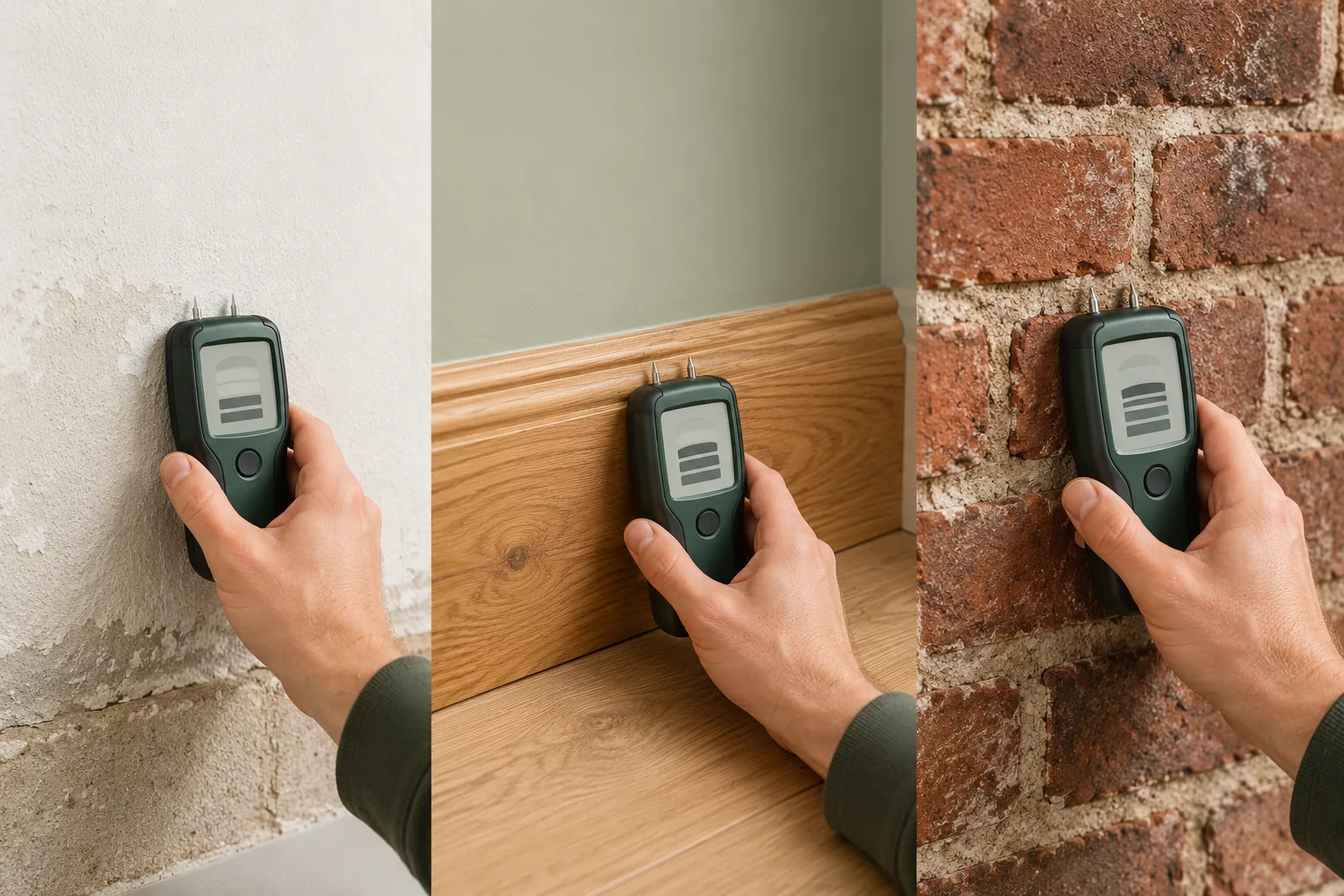
The condition of the surface also matters. Freshly cleaned, recently painted or cold surfaces can produce a different context from the same area on another day. So can a material that has dried at the face while retaining moisture deeper inside. A meter used only at the centre of a visible stain may miss the shape of the affected area; a meter used indiscriminately over mixed materials may create a misleading map.
Why salts and hidden materials complicate readings
In some older buildings, a wall may have been wetted and dried repeatedly over decades. Soluble salts can remain in the plaster after the liquid water has gone. Because those salts affect electrical behaviour, a resistance-type reading can stay high for reasons that cannot be separated from active wetting by that reading alone. Historic England’s guide to assessing damp in historic buildings explains why the method and the building fabric need to be considered together.
There are other possible interferences. Metal corner beads, fixings, foil insulation, electrical cables and plumbing can sit close to a surface. A pinless instrument may react to a change in the assembly rather than a change in water content. This does not make the instrument useless. It means an isolated spike should lead to a question: what lies behind this spot, and does the same pattern appear where the construction is comparable?
The answer may require checking construction drawings, looking from an accessible adjoining space or taking a different type of measurement. It may also require saying that the source remains uncertain until a section can be opened safely. An honest limitation is more useful than a confident label based on one display.
Build a comparison before drawing a conclusion
A careful survey typically compares readings in a repeatable way. The surveyor may move across a wall, up its height or around the edge of a ceiling mark, noting changes along with the materials, finishes and nearby features. An apparently unaffected area of similar construction can act as a reference. The comparison is not a universal “dry standard”; it simply helps show whether the suspect area behaves differently under similar conditions.
For example, a high band beneath a window might raise questions about the window detail, condensation on a cold reveal and rainwater entry. Its position alone cannot choose between them. A high indication beside a bathroom pipe route might warrant a plumbing check, especially if the wall changes after water use. A cold external corner with mould but no visible stain needs temperature, humidity and airflow context as well as any meter readings. Our mould inspection service considers that wider picture rather than assigning a cause from the display alone.
Keep a record of each point if the condition is recurring. A simple floor-plan sketch with dates, weather, room use and repair history is often more useful than a photograph of a meter screen. If you want to track a changing stain yourself, our guide to why a damp patch can appear away from its source explains why the visible mark may not identify the entry point.
What a repeat reading can and cannot show
Repeated readings can help show a trend when the method is consistent. If the same points on the same material are checked with the same instrument under similar conditions, a falling pattern may support evidence that an area is drying. A rising pattern after rain or plumbing use can help direct the next check. Neither pattern proves the source by itself. Changes in room temperature, relative humidity, surface finish or meter settings can also affect the comparison.
Record more than the display. Note the date, the exact position, the surface material, visible staining, odour, room temperature if available and whether the area has recently been heated, ventilated or cleaned. If a repair was made, write down what was repaired and when. A mark can remain after the material dries, while a fresh coat of paint can conceal active wetting for a time. Historic England’s drying guidance stresses the value of monitoring conditions and interpreting drying in relation to the building.
Avoid repeatedly pushing pins into a protected finish, electrical area or unfamiliar wall build-up. Home meters are useful for observation, but a person should not dismantle a ceiling, drill into concealed services or decide on major treatment because a screen displays a high number.
When another method is needed
Sometimes the uncertainty is about depth. A surface measurement may not establish what is happening inside a solid wall, within insulation or behind plasterboard. Sometimes the uncertainty is about the kind of moisture: liquid water entering through a defect, water condensing on a cold surface or humidity absorbed and released by the material. Temperature and relative humidity measurements, visual inspection of accessible areas, plumbing checks or carefully planned opening-up may help separate those possibilities.
Thermal imaging can be useful in the right conditions, but a cooler patch is not proof of a leak. Shading, air movement, insulation gaps and different materials can also produce temperature patterns. The value comes from combining methods and checking a leading explanation against the building’s history. A damp inspection should make clear which observations support its conclusion and where access or evidence limits certainty.
Before agreeing to remedial work, ask what material was tested, which instrument and scale were used, how reference areas compared, what other evidence supports the proposed cause and what would disprove it. Ask whether the recommended repair addresses a water source or only the visible finish. Those questions are particularly useful when the proposal involves removing sound material or treating a large area from a few readings.
Treat the display as one clue
A meter is valuable when it is used to compare, map and monitor moisture conditions in context. It is much less persuasive when a single number is presented as a complete diagnosis. The strongest next step may be a small, targeted check rather than a broad repair: observe a roof junction after rain, test a suspected pipe, compare similar surfaces or gain safe access to a concealed void.
If readings are repeatedly elevated, a stain is growing or the source remains unclear, contact our team with photographs, dates, the room layout and any recent repairs. That information helps frame a proportionate investigation and a report that explains both the evidence and its limits.