
How to Record a Recurring Damp Patch

A damp patch appears, fades and then returns. By the time someone comes to inspect it, the surface may look almost normal. That makes a precise account of what happened more valuable than a guess about the cause. A short record can show whether the mark follows rain, water use, a change in heating or a repair. It can also show that several explanations remain possible.
The aim is to help the next person investigate efficiently. You do not need specialist equipment or a complicated spreadsheet. A phone camera, a few consistent notes and a simple sketch are enough to capture changes that memory tends to blur. Start as soon as you notice the problem; do not wait for a pattern to become obvious.
Establish a clear starting point
Begin with the room and the exact surface. Write “north-facing bedroom, external wall, 30 cm above the skirting, beside the left edge of the window” rather than “damp in the bedroom”. If the property is a flat, note the floor level and what lies above, below or on the other side where you know it. A mark on a party wall, a ceiling under a bathroom and a window reveal call for different questions.
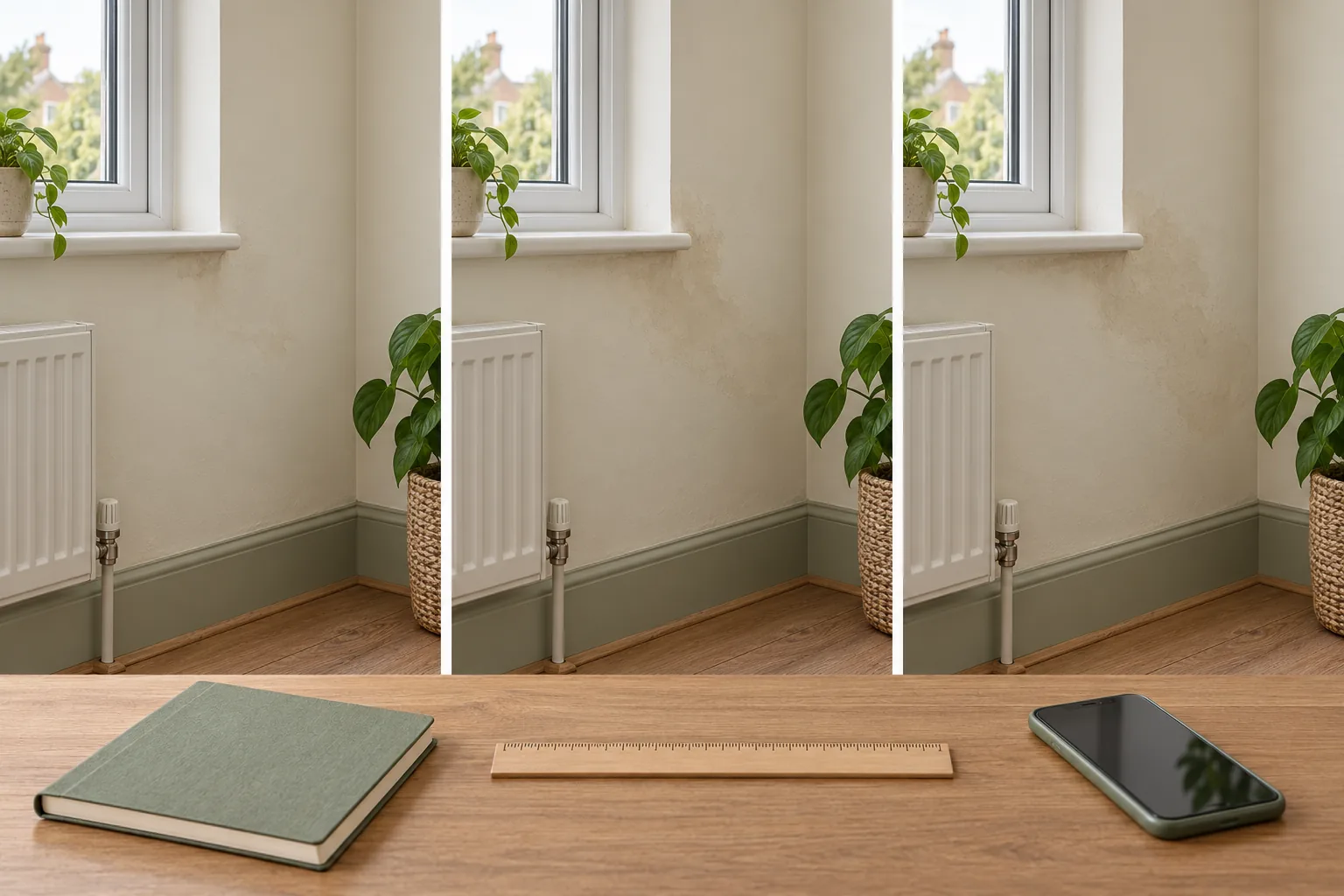
Take one wide photograph that shows the patch in the room and one closer view that shows its edge. Include a ruler or another familiar object for scale, but keep the same object and position in later images. A strip of low-tack tape next to the stain can be a reference point; do not stick anything to fragile wallpaper or flaking plaster. Record the date and time separately from the photograph, because shared image files can lose their metadata. If the surface is glossy or the light changes, photograph it from the same angle whenever possible.
Make a rough plan or elevation. Mark windows, doors, radiators, sockets, pipe boxes, roof slopes and nearby bathrooms. The drawing need not be to scale. Its purpose is to let a surveyor compare the location with the building layout rather than infer it from a tightly cropped image. Photograph any obvious external feature that may be relevant only from a safe, accessible position. A stain beside a downpipe does not prove a downpipe fault, but the relationship deserves recording.
Record change, not just presence
At each check, describe what changed since the last one. Did the boundary spread, shrink or stay still? Is the colour darker, or is the surface merely marked? Is paint blistering, plaster softening, or wallpaper lifting? Is there a musty smell at the same location? Write what you observed, then keep your proposed explanation in a separate line. “Brown edge extended two centimetres after overnight rain” is an observation. “Roof leak” is a hypothesis.
Check at a sensible interval. During an active leak, daily notes may be useful until help arrives. If the condition is stable and intermittent, a photograph after significant rain or a weekly check may reveal more than many near-identical pictures. Do not delay urgent action to gather a perfect record. Water near an electrical fitting, a sagging ceiling or a rapidly spreading leak needs appropriate immediate help, and the affected area should be kept clear.
If you need a compact format, use five columns in a notebook or phone note: date and time; visible change; recent weather; relevant water use or indoor conditions; and action taken. Add a photograph number in the last column. That small structure prevents a common problem: a folder full of images with no explanation of what was happening in the property at the time.
Note weather carefully without assuming the source
Rainfall matters, but a statement such as “it was wet outside” is not specific enough to test. Note whether rain was heavy or prolonged, whether there was strong wind, and whether the patch changed during the event or the next day. A defect may admit water only when rain is driven against one face of the building. Another route can take time to show on the interior surface. You do not need to calculate rainfall totals; the dates and a plain description allow a professional to compare them with local weather records if necessary.
Also record dry periods. If a mark remains unchanged through several storms but worsens after a shower upstairs, that weakens one explanation and strengthens another. If a stain becomes clearer on cold mornings without rain, surface condensation may need consideration. These comparisons are clues, not a home diagnosis. Our article on why a damp patch can appear away from a leak explains why the visible point may be some distance from the entry point.
Avoid changing several conditions at once simply to run a test. Turning off all heating, sealing vents and altering normal water use could make the room less representative and may cause other problems. Record normal occupancy and any unavoidable changes. If a repair or maintenance visit alters the conditions, note that date clearly so the later trend is not misread.
Include water use and indoor conditions where relevant
For a patch near pipework or below a bathroom, note when a bath, shower, sink, washing machine or heating system was used and whether the stain changed afterwards. Do not dismantle fittings or run an appliance repeatedly to provoke a leak. A simple chronology can help a plumber decide where to inspect safely. In a flat, the relevant service may be shared or located in another unit, so record what access has been available and what remains unknown. Our hidden leak checks page describes how concealed routes may need targeted investigation.
For a cold corner or a wall behind furniture, include information about heating, ventilation and room use. Was the room unheated for several days? Was a window opened or an extractor repaired? Was a wardrobe moved away from the external wall? A low-cost thermometer and humidity monitor can add context if used consistently, but a single humidity number does not prove a moisture source. Take care not to turn a log into a collection of disconnected device readings.
If mould accompanies the patch, photograph and document its position before cleaning where safe and appropriate. GOV.UK guidance for rented housing providers recommends recording the location of mould before removal because it can help identify the source. The same guidance makes clear that mould and underlying moisture need prompt attention. A record should support action, not become a reason to leave a harmful condition in place.
Keep a repair history in the same timeline
Recurring problems are difficult to understand when earlier work is described only as “fixed last year”. Record the date of each visit, what was inspected, what was repaired, and what material was replaced or treated. Keep copies of reports, invoices, emails and photographs from before and after the work. If the gutter was cleared but the wall remained stained, note whether it actually dried or merely looked less obvious. If plaster was renewed, note whether the source was identified first.
After a repair, compare like with like. A dark stain can remain after active wetting stops; a newly painted surface can hide wetting for a time. Monitor changes in the boundary, surface condition and timing rather than treating colour alone as a pass or fail result. Do not expect a damaged material to become visually perfect immediately. Ask the contractor or surveyor what observable change should follow the specific repair and over what conditions that expectation can reasonably be tested.
For a rented home, keep a factual record of when the concern was reported and the responses received. State the problem and the effect on the room without speculating about blame. The GOV.UK tenant guide to housing hazards advises written communication and keeping photographs and records. The details of responsibilities and remedies depend on the tenancy and circumstances; a practical property log is useful whichever route applies.
Prepare a concise handover for an inspection
Before an appointment, turn the log into one page: where the patch is, when it was first noticed, when it changes, the strongest weather or water-use relationships, previous repairs and any access limitations. Choose a few dated photographs that show meaningful change. Keep the full collection available if requested, but do not expect someone to interpret dozens of unlabelled pictures during a short visit.
Tell the inspector what you have not observed as well as what you have. “No change after the last two periods of heavy rain” may be important. So may “the upstairs bathroom was not in use while the patch enlarged”. If you do not know what is behind a wall or whether a roof space is accessible, say so. That uncertainty can shape a sensible next step in a damp inspection.
A good record cannot replace an on-site assessment. It helps the person attending decide what to inspect first, which explanations remain plausible and whether monitoring, plumbing work, external access or controlled opening-up is warranted. It also helps everyone judge whether a repair addressed the actual problem later. If a recurring patch in a London property remains unexplained, contact our team with the one-page summary and photographs; we can advise on an appropriate inspection route.