
Why a Wall Can Feel Damp but Read Dry

You put a hand against a bedroom wall and it feels clammy. A handheld meter, used a few minutes later, shows a low reading. The two impressions seem to disagree. Neither should be treated as a verdict on its own. Touch responds strongly to temperature and surface finish; a moisture meter responds to particular properties of the material in the area it tests. A wall can feel cold without being actively wet, and a low meter display does not prove every layer behind the finish is dry.
The useful next step is to describe exactly where and when the sensation occurs. Does the wall feel different on cold mornings? Is it only one corner or the whole external wall? Are there droplets, staining, mould or a musty smell? Do similar surfaces elsewhere in the room feel the same? Those comparisons help separate a cool surface from surface condensation and from moisture moving through the building.
Your hand senses heat transfer as well as water
A wall can feel damp because it takes heat from your skin more quickly than the material beside it. Dense masonry, tile and some painted surfaces often feel cooler than timber or fabric in the same room. A cold patch on an external wall may reflect a construction junction, reduced insulation, a thermal bridge or a space behind furniture where warm air does not circulate. The sensation is real, but it is not a measurement of liquid water.
Temperature also changes with the season and with heating patterns. A room that was warmed briefly before an inspection may have comfortable air while its wall remains cold. A wall near a poorly insulated reveal may feel especially chilly in winter. If the same patch feels normal after a sustained period of mild weather, that pattern points towards a temperature explanation worth testing. It does not rule out another defect, especially where visible damage is also present.
Try comparing equivalent parts of the wall with the back of your hand, but do not press repeatedly on mould or deteriorating plaster. Note the exact position and whether the sensation follows a joint, corner or furniture outline. A wide photograph can preserve the context better than a close-up of a meter screen.
Surface condensation can be brief and local
Warm air holds water vapour produced by everyday activities. When that air meets a sufficiently cool surface, water can condense there. The film may be subtle, intermittent or gone by the time the meter is used. A cold window reveal, the corner of an unheated bedroom or the wall behind a wardrobe can collect surface moisture while the nearby wall stays visibly dry. Oxford City Council’s condensation guidance identifies cold surfaces, poor ventilation and everyday moisture sources as relevant conditions.
Look for the timing. Does the wall feel clammy after sleeping, showering or drying laundry, then improve later? Is the window wet at the same time? Are there small mould spots in other cool, poorly ventilated places? Condensation may explain that cluster. A single touch after a shower cannot show whether the wall also has a rainwater or plumbing problem. The two can coexist, so keep an open mind if the patch changes after rain or pipe use.
Do not try to prove condensation by closing vents or turning off heating. That changes the conditions and can make a problem worse. Record ordinary use of the room, ventilation and heating over several days. If the room is rented, share the observations promptly with the person responsible for repairs. A log supports investigation; it should never become a reason to leave mould untreated.
A meter tests a limited zone, under particular conditions
Many handheld meters estimate moisture indirectly. Pin-type instruments respond to electrical resistance between their contacts. Pinless instruments respond to an electromagnetic field beneath the face. The depth and material represented by a reading depend on the device, setting and surface. A low number on one plaster patch means only that the instrument gave a low response there at that time.
The comparison is often more useful than the absolute number. If the suspect wall and a similar unaffected wall have comparable construction and finish, readings at marked, repeatable locations can reveal a pattern. Mixed plaster, foil-backed lining, metal fixings, salts and layers of paint complicate interpretation. Our guide to what a moisture meter reading can really tell you explains those limits in more detail. The RICS and Historic England position statement on moisture also emphasises examining the building and interpreting measurements in context.
Do not chase a particular meter number by testing random spots until one looks convincing. Record the material, location, device mode and time if readings are taken. If you did not make the reading yourself, ask which instrument was used and what was compared. “Dry” should be a reasoned conclusion from the overall evidence, not shorthand for one display.
A concealed layer may remain affected
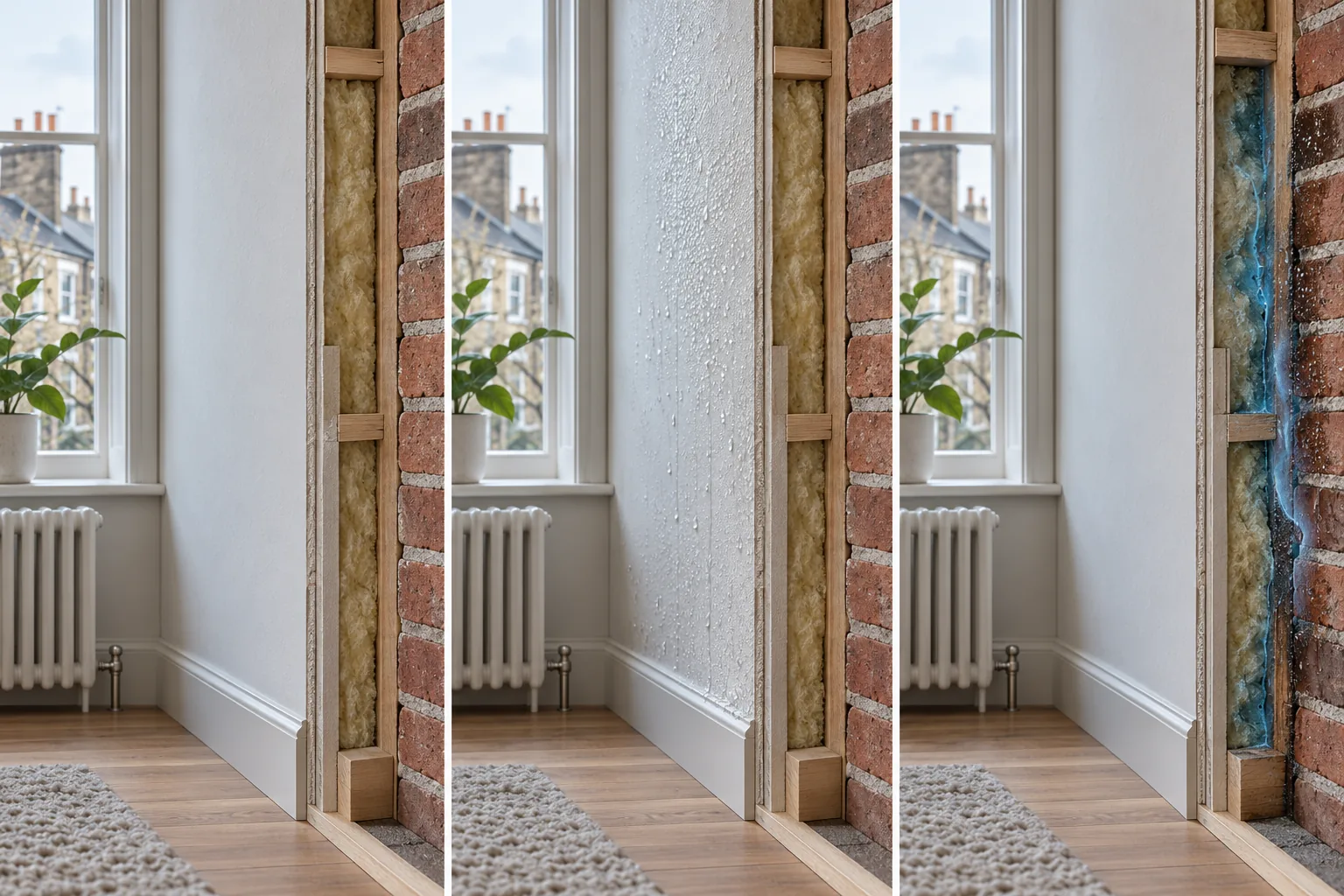
The meter’s response at the accessible face may not describe the condition of insulation, timber, a cavity or a pipe chase behind it. A surface can dry after a leak while an enclosed layer remains wet. Conversely, old staining may remain after the underlying cause has been repaired and the fabric has dried. The wall’s history and construction matter in both cases.
Consider a plasterboard lining on an external wall. If air moves through a void or water enters behind the board, the room-facing surface may show little until damage progresses. A non-invasive inspection can compare the visible pattern and accessible details, but it may not confirm every hidden condition. Our article on what a non-invasive moisture inspection cannot see explains when a focused follow-up or agreed opening-up may be justified.
There is no need to cut into a sound wall because it feels cool. Opening becomes more reasonable when there is persistent damage, a credible hidden route or a decision that depends on knowing the concealed condition. An inspector should explain what question the opening would answer, who can authorise it and which competent trade should carry it out.
Check the pattern before choosing a remedy
Make a short map of the affected area. Mark any cold or clammy zone, visible staining, mould, peeling finish and skirting damage. Photograph it with room context, and note whether it changes after rain, water use or cold nights. Check safe, visible exterior details from the ground where relevant, such as a gutter overflowing onto the same wall. Do not assume that the closest outside feature is the cause.
Compare the wall over more than one condition. A surface that feels clammy only after a humid night may suggest a different route from a stain that enlarges after wind-driven rain. A pipe leak may follow use of a bath or heating system. GOV.UK’s guidance on damp and mould stresses identifying and addressing the moisture source rather than relying on a surface treatment alone.
If you have a temperature and humidity monitor, use it for a consistent record rather than a single decisive reading. Record room conditions at similar times, and distinguish air temperature from surface temperature. An infrared thermometer can help compare surface temperatures, but reflective finishes, distance and angle affect its result. Thermal imaging can show patterns but cannot label a blue or cold-looking patch as “wet” without corroboration. A competent surveyor should state how any instrument contributed to the conclusion.
When to seek an inspection
Arrange appropriate help promptly if water is spreading, a ceiling is soft or sagging, or moisture is near electrical fittings. Keep clear of the affected area. A stable but recurrent problem also deserves assessment if mould appears, finishes continue to deteriorate or the room cannot be used comfortably. Tell the inspector both sides of the apparent contradiction: where the wall feels damp and what the meter showed. Include when each observation was made.
An effective damp inspection should compare the history, visible fabric, indoor conditions and accessible building details. It may find a cold surface with intermittent condensation, an active water route or more than one factor. If the evidence remains uncertain, the report should say what would test the leading explanations next. For a London property with a persistent cold or clammy wall, contact our team with photographs, timing and previous readings so we can suggest a sensible assessment.