
Stains That Return After Repainting
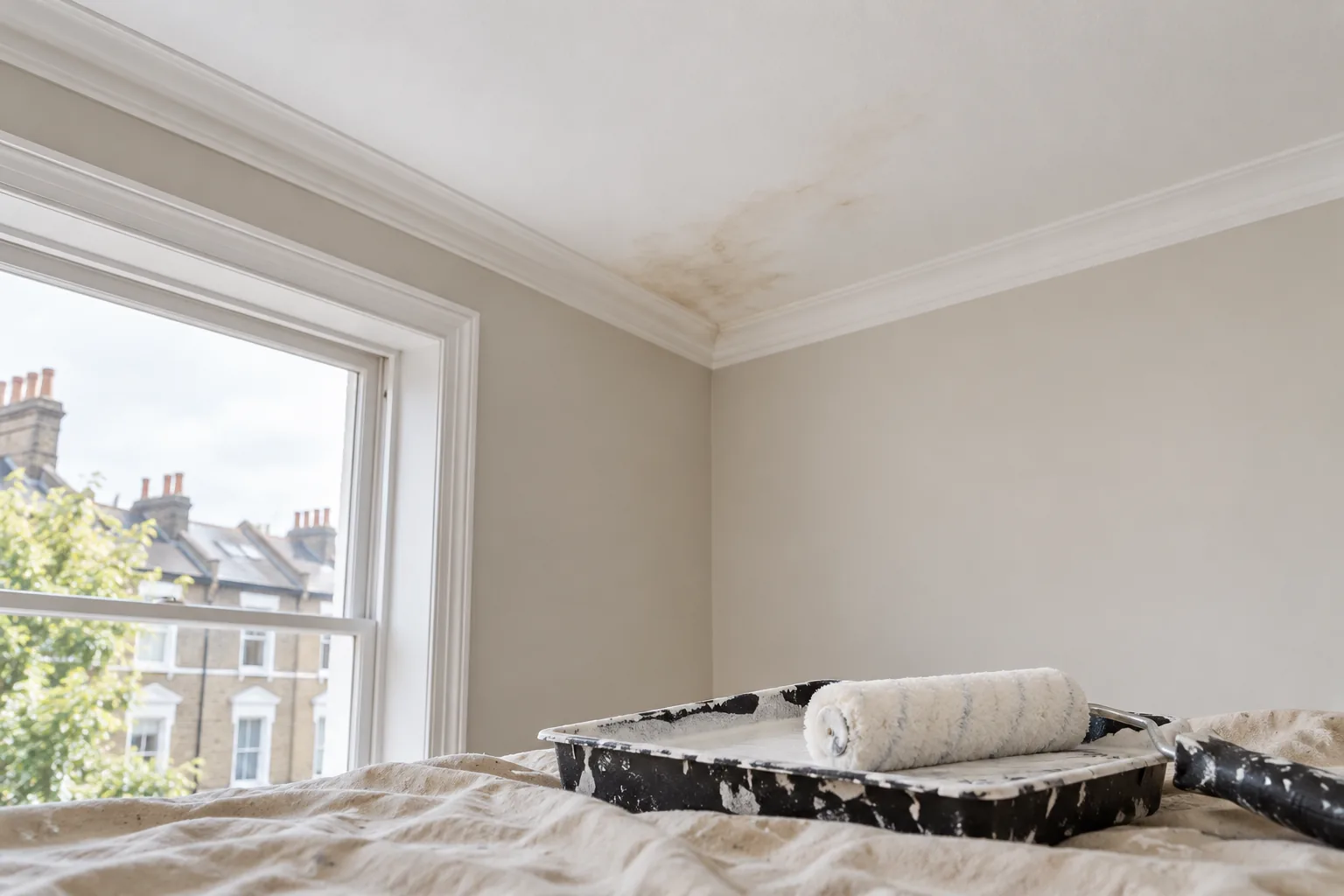
A brown mark shows through a ceiling a few weeks after it was painted. The first reaction may be to apply another coat, this time with a stronger stain-blocking primer. That might deal with discolouration in a dry, sound surface. It will not stop water entering again. Before redecorating, establish what has returned: an old mark bleeding through the finish, new moisture, or both.
The distinction matters because paint can hide the evidence for a while. If a repair to the roof or plumbing was made before decorating, a new stain may suggest that the source remains active, another route exists or the material was not ready to be finished. A stain can also persist after the source has genuinely been fixed. The useful approach is to record the change, compare it with the history and inspect the likely route before choosing a product.
Start with the timeline
Write down when the original stain appeared, when any leak or building defect was found, what repair was carried out and when the surface was painted. If you do not have an invoice or report, note what you know and what remains uncertain. “Gutter cleared in March” is different from “roof junction repaired and checked after heavy rain”. The type of work determines what you should expect afterwards.
Record the date when the mark became visible through the new finish. Did it show as the paint dried, after a first rainstorm or after an upstairs bathroom was used? A mark that reappears immediately through a fresh coat can be old staining bleeding through an unsuitable coating. A mark that grows after weather or water use raises a different concern. The timing is a clue, though it cannot identify the fault by itself.
Photograph the whole wall or ceiling and then the stain with a ruler for scale. Use consistent lighting for later photographs; a warm lamp can make a mark look darker than daylight. Do not rely on colour alone. Note whether the boundary is spreading, paint is blistering, plaster is soft, the surface feels wet or a musty smell has developed. Our guide to recording a recurring damp patch offers a compact way to keep these observations together.
Old staining can bleed through paint
Water can carry discolouring materials into plaster, lining paper or timber. Even after a source has been repaired and the material is dry, an old stain may migrate through a new coating. A normal emulsion is designed as a finish, not necessarily as a barrier to every contaminant. An early return of the same shape with no other change may be consistent with bleed-through.
That possibility should be checked rather than assumed. The room-side surface might be dry while a concealed layer remains affected. Equally, an old patch can remain visually obvious without active wetting. Compare the stain’s shape and edge with dated photographs from before the repair. If it is precisely the same shape and stable through relevant weather and water use, residual discolouration becomes more plausible. If a new halo forms or the boundary moves, investigate renewed moisture.
A stain-blocking coating has a place after the source is addressed and the surface condition is suitable. Follow the manufacturer’s instructions for the material and ventilation, and seek competent advice if plaster is crumbling or contaminated. Painting over a soft, mouldy or repeatedly wet substrate is likely to waste work and may conceal deterioration.
New moisture may follow a route beyond the visible mark
A ceiling stain below a bathroom may relate to a bath seal, waste fitting, supply pipe or water tracking along a joist. The mark does not show which component leaked. On an external wall, rainwater might enter at a window detail, roof edge, gutter or crack and travel before appearing inside. A stain after repainting can seem to “move” simply because the new finish masks one part of an older path while another part becomes visible.
Compare the timing of change with rain, wind and water use. Ask whether the mark grows during a storm, the next day, or after showers upstairs. Look for safe, visible signs such as an overflowing gutter or a dripping fitting. Do not climb onto a roof, lean out of a window or open a ceiling to prove a guess. A damp inspection can map the pattern and determine which access or specialist check would be useful.
In flats and converted properties, the source may be outside the room or unit where the stain appears. A shared roof, pipe riser or neighbouring bathroom may require coordinated access. Photograph the stain and share a factual timeline with the managing agent, landlord or relevant neighbour rather than attributing blame from the position alone.
Check the repair, not merely the paint
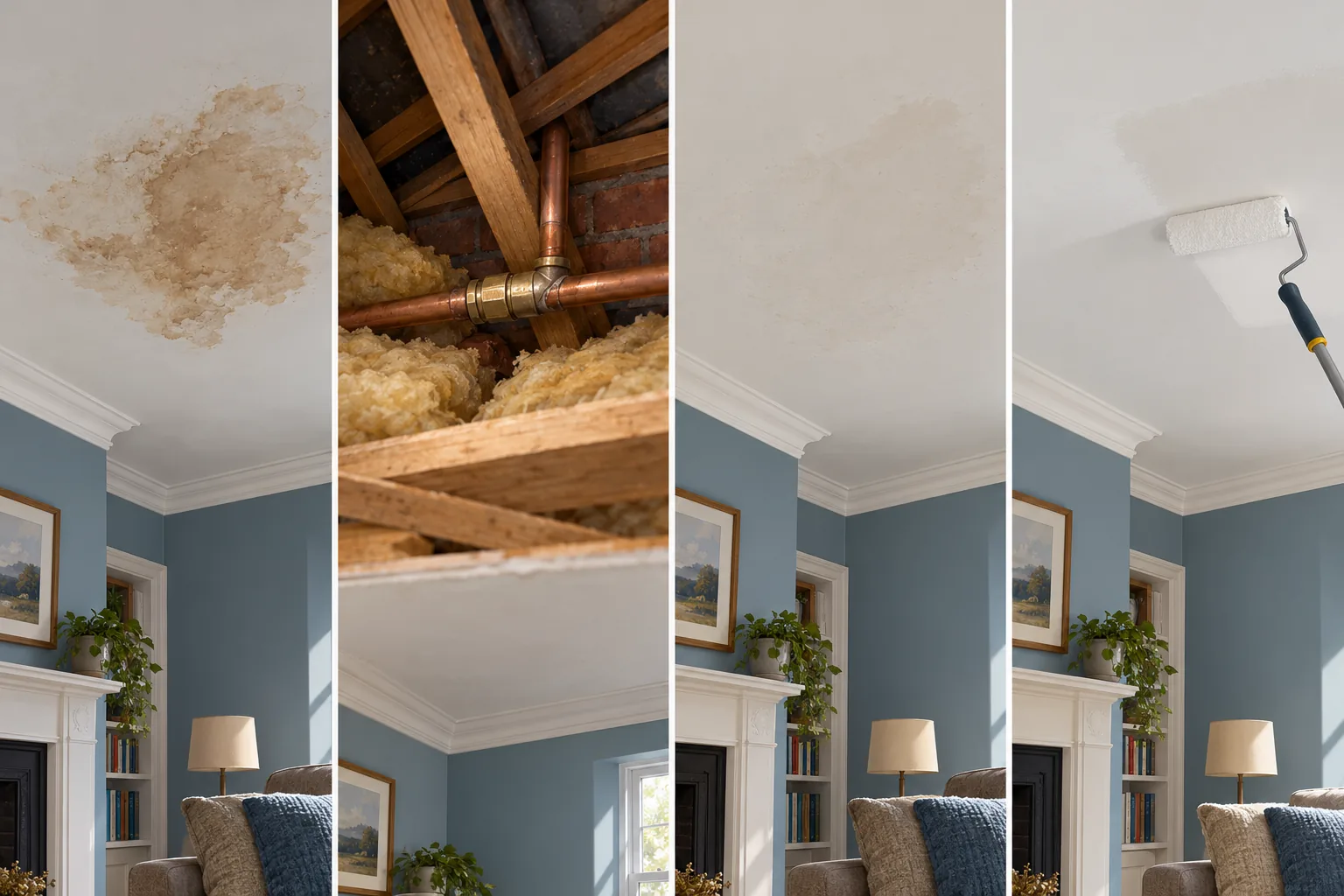
If someone previously repaired a suspected source, ask what defect was actually found and what work was completed. Was a joint resealed, a pipe replaced, a gutter cleared or a roof covering repaired? Was any test or follow-up observation planned? A repair to a visible nearby feature can be reasonable, but it should have a credible route to the stained surface.
After repair, a damp material needs time and suitable conditions to dry. The period varies with construction, how much water entered, ventilation and which layers were affected. Avoid a fixed promise such as “paint after one week” without checking the material. A contractor may be able to take comparable readings at marked points over time and explain whether they support drying. Our article on moisture meter readings explains why one number is not proof of readiness.
Ask what change should follow the particular repair. If a gutter overflow was stopped, does the interior mark remain stable through the next significant rain? If a waste fitting was repaired, does the ceiling stay unchanged during normal use? A stain can remain even when moisture stops; the more useful signal may be no new halo, no softening and a drying trend. Conversely, a newly painted ceiling can look clean for a while despite continuing wetting.
Distinguish stain bleed, active wetting and condensation
Think of three broad questions. First, is there a stable historical mark beneath the new finish? Second, is water still arriving through a defect or service? Third, could moisture be forming on the room-facing surface? Condensation is more likely on cold surfaces with humid air and poor circulation; it can coexist with a building defect. A mark near a cold corner or window reveal deserves a look at room conditions, while a ceiling stain beneath pipework deserves attention to water use.
Do not use a single handheld meter reading as a tie-breaker. Electrical readings can be affected by materials, salts and metal; a surface reading may not describe a void behind it. Historic England’s guide to assessing damp explains why building context and appropriate methods matter. A surveyor should combine history, visible condition, comparable measurements and accessible details.
If the stain appears after every repaint, compare what was actually done each time. Repeated painting with no investigation does not test the source. Repeated leak repairs with no monitoring may leave uncertainty about which route mattered. Keep a small file of dates, photographs and repair descriptions so the next inspection begins with evidence rather than another guess.
Prepare the surface only when the cause is understood
Once active wetting has been addressed and the material is judged suitable, decoration can proceed in the right order. Loose paint, degraded plaster or mould may need separate assessment and preparation. The chosen primer should match the substrate and type of stain; the final coat should follow its drying and application instructions. A decorator can advise on finish, but should not be expected to diagnose a concealed roof or plumbing fault from paint behaviour alone.
If mould appears, address the moisture source and the affected material promptly. GOV.UK guidance for rented housing providers makes clear that removing visible mould without resolving underlying moisture is insufficient. Keep photographs of the location before cleaning where safe, then arrange appropriate action. Do not leave a harmful condition untreated merely to preserve evidence.
Water near electrics, a sagging ceiling or an active leak calls for urgent appropriate help and a clear area beneath the damage. For a stable stain, a careful sequence is more useful than a rapid third coat: record the pattern, review previous repairs, assess the likely moisture route, monitor or test where needed, then redecorate once the source and substrate are suitable. If a mark continues to return in a London property, contact our team with the timeline and photographs so we can advise on the next inspection step.