
Damp at a Skirting Board: Where to Look First
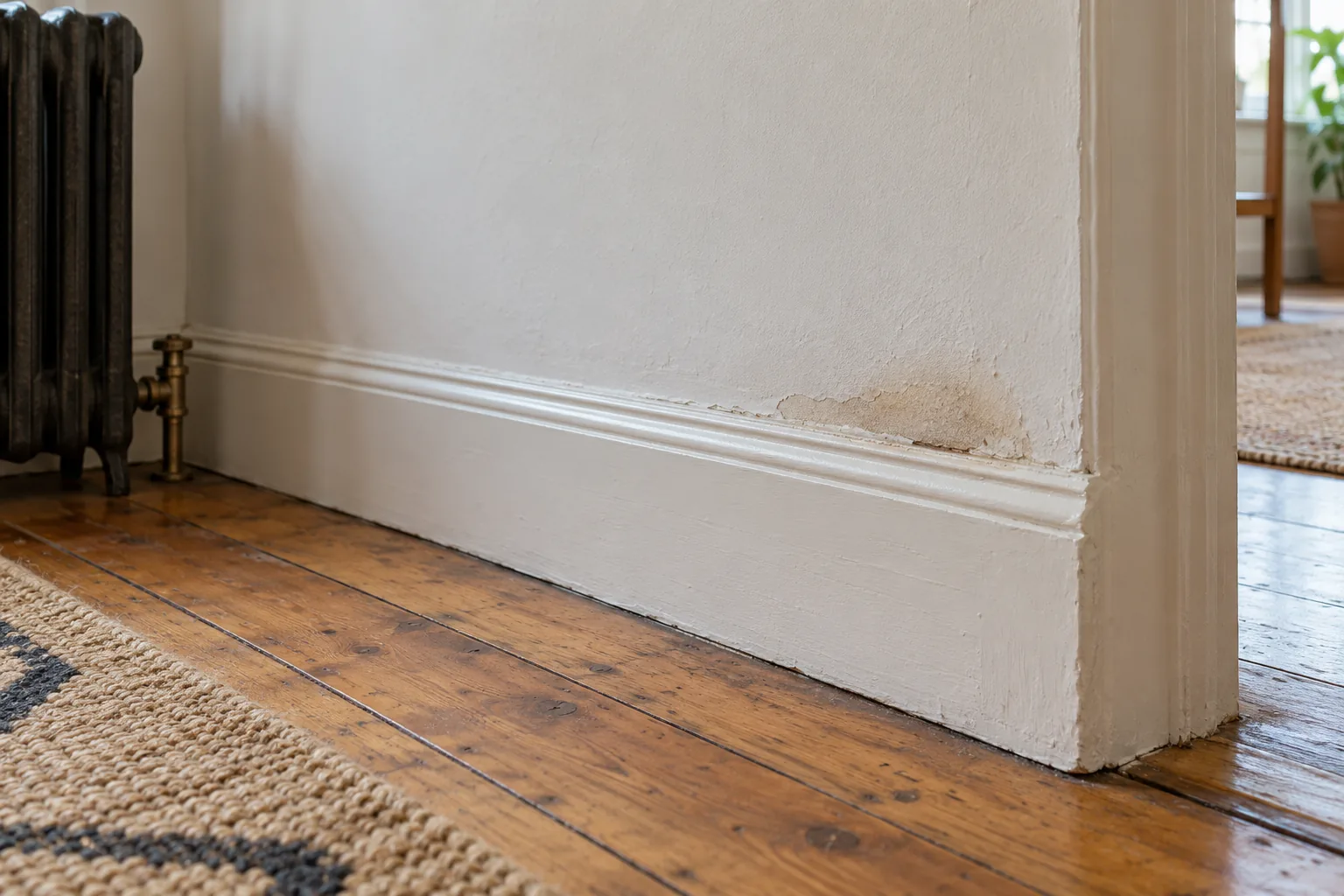
A dark line beside a skirting board is often called “rising damp” before anyone has checked the room. That label is a hypothesis, not a diagnosis. Water near floor level can come from plumbing, rainwater outside, a wet floor edge, condensation on a cold wall or moisture moving through the building fabric. The same room may have more than one contributing factor.
Start by recording the exact location and pattern. Is the skirting itself soft or swollen? Is there a stain above it, a gap in the flooring, mould behind furniture or a musty smell? Is the affected wall external, beside a bathroom or near a radiator pipe? Those details help decide which route to inspect first. Avoid stripping finishes or paying for a damp-proofing treatment solely because the mark is low on the wall.
Map the affected edge before it changes
Take a wide photograph showing the whole wall and its position in the room, then a closer view with scale. Mark the point where damage begins and ends along the skirting. Note whether it is on one short section, the full wall or more than one room. A patch directly beneath a radiator valve raises different questions from a continuous band beside a cold external wall.
Describe the materials. Painted timber, MDF, vinyl, laminate and plaster can respond differently to water. MDF may swell irreversibly after a past event, so a swollen board does not by itself prove that water is still arriving. Salt marks or peeling paint may remain after drying. Record any change in size, colour, softness or smell over time rather than relying on one inspection.
Do not pull off the skirting simply to see behind it. If it is loose or rotten, note the condition and ask who can authorise and perform a controlled inspection. In a rented home, report the problem and preserve photographs. If the wet area is spreading or electrical outlets are affected, arrange appropriate help promptly.
Look at nearby services and water use
Pipes often run behind skirtings, under floors or up a service chase. Check for accessible signs of a leak: drips at a radiator valve, a wet pipe, water around a washing machine or a damp cupboard backing onto the affected wall. A leak from a bathroom, kitchen or heating circuit may travel under floor coverings before appearing at a room edge. The source may be metres from the visible stain.
Note when the mark changes. Did it appear after the heating was turned on? Does it worsen after showers or a washing machine cycle? A water meter or pressure change may be relevant to a plumber, but homeowners should not dismantle fittings or repeatedly run appliances to provoke a leak. If a fitting is actively leaking, follow an appropriate urgent repair route and keep the area safe.
In a flat, pipework may be shared or belong to the neighbouring unit. Record which rooms and services lie beyond the wall and whether access is available. A targeted hidden leak check can be more useful than replacing the skirting before the route is known.
Compare the outside of an external wall
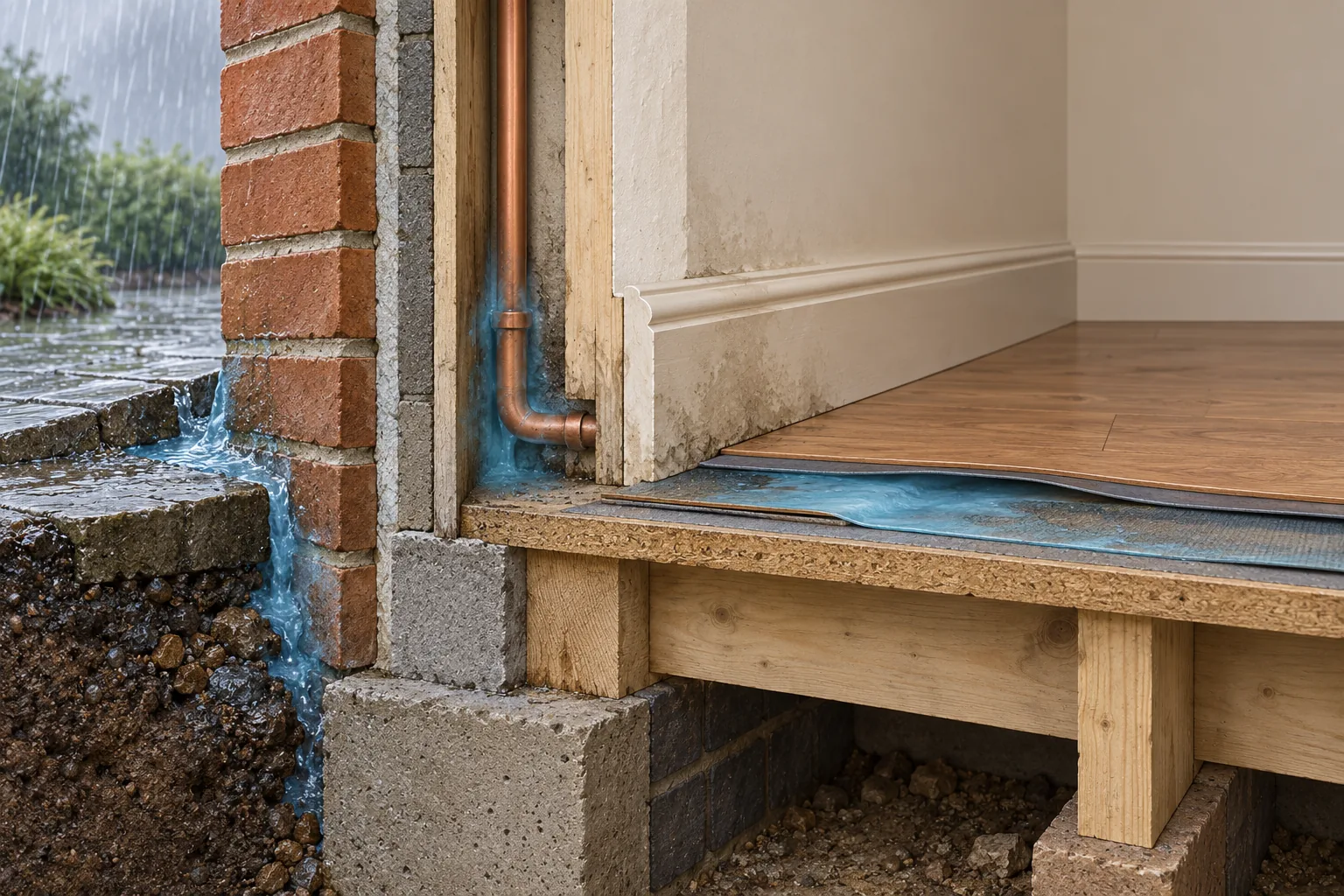
For an external wall, look from a safe, accessible position at ground levels, paving slopes, drainage, rainwater goods and any opening near the affected section. Is a downpipe discharging at the base of the wall? Does water pond against the building during rain? Is there a gap at a door threshold? Are external levels high relative to the internal floor? These observations do not prove a mechanism, but they help prioritise a closer investigation.
Rainwater may move through a defect in the wall or around an opening before showing at the skirting. The visible point can be some distance from the entry point. Compare the timing with more than one rain event, including dry periods. A mark that grows after wind-driven rain should prompt different checks from one that changes after bathing or heating use. Our guide to damp patterns after heavy rain explains why correlation alone is not proof of a route.
Traditional solid walls and modern cavity walls behave differently, and previous alterations may change drying. Historic England’s guide to assessing damp stresses examining building construction and defects before prescribing treatment. A surface coating or injection cannot fix a dripping pipe or a blocked drain.
Check the floor and its edges
The flooring may be the path rather than the source. Water from a kitchen appliance can travel beneath vinyl, laminate or carpet and collect at a wall edge. A past leak may have soaked an underlay or timber floor before a visible stain appeared. If the floor feels soft, boards have lifted or a covering smells musty, the material beneath may need assessment.
Floor coverings can also change how moisture evaporates. A dense covering over a damp substrate may trap water and shift where it becomes visible. Do not lift a large area without a plan, especially in an older property where materials and services may require care. Record what can be seen at thresholds or existing access points. If a repair decision depends on the hidden condition, a competent person can propose a focused opening.
Clean water spills can also leave staining or swollen skirting long after the event. Ask whether a flood, plumbing repair or wet cleaning happened before the mark was noticed. A reliable timeline prevents an old material defect from being mistaken for a new source.
Cold corners and condensation deserve a separate check
A skirting line can be a cool, poorly ventilated surface, particularly behind furniture against an external wall. Moist indoor air can condense there, leaving mould or dampness even without water coming through the wall. Look for similar mould behind a wardrobe, water on nearby windows and a pattern that worsens on cold mornings. Oxford City Council’s condensation advice identifies cold surfaces, limited air movement and indoor moisture as relevant factors.
The location of mould can be useful, but it is not a conclusive test. A leak may cool materials and make condensation more likely. A room can have a plumbing problem and inadequate ventilation at the same time. Record normal heating, ventilation and furniture layout, then compare with weather and water use. Do not reduce heating or close vents to “test” the idea.
Where the skirting is painted or coated, touching it can be misleading. A cold dry board may feel clammy; a recently wiped surface may be briefly damp. Visible mould or continuing deterioration still needs attention. The aim is to understand whether moisture is forming at the face, arriving from behind or both.
Treat meter readings as one part of the evidence
A high or low meter reading at skirting level cannot identify the route. Electrical readings can be affected by salts, metal fixings, different woods, paint and mixed construction. A low reading on the plaster above does not establish that a floor void is dry. A high reading on one board does not prove “rising damp”. Compare similar materials at marked points and record the instrument and conditions.
The RICS and Historic England statement on moisture supports an investigation that combines building history, defects and proportionate measurements. Our article on moisture meter readings explains why a single display should not dictate a costly repair. Ask an inspector how the readings relate to the stain, construction and possible water sources.
Choose the next check from the strongest clues
Summarise the evidence in a few lines: the location, when it first appeared, what changes it, nearby services, floor condition, external details and previous repairs. If a plumbing route fits best, ask a plumber or leak specialist to test it. If rainwater details align with the pattern, seek safe external inspection. If cold-surface condensation appears likely, assess room conditions and the building’s ventilation and insulation details. More than one specialist may be needed where routes overlap.
Do not replace a damaged skirting and repaint until the source is addressed and the adjoining material is suitable. The finish may need repair even after the moisture stops, but cosmetic work should be the last stage. GOV.UK guidance on damp and mould emphasises identifying the underlying source and addressing mould promptly.
If the edge remains wet, mould spreads or earlier work has not solved the problem, a damp inspection can compare the wall, floor, services and accessible exterior. For a London property, contact our team with photographs and a short timeline. That gives the first visit a focused question rather than a label chosen from the stain’s height.