
Why One Bedroom Corner Gets Condensation

Most of a bedroom wall looks clean, yet one corner repeatedly feels damp or develops small mould spots. It can seem strange that the problem is so local. Condensation depends on the temperature of a surface as well as the amount of water vapour in the room and the movement of air across it. A corner can remain colder and less ventilated than the wall beside it, so it reaches damp conditions first.
That is a useful starting explanation, not a diagnosis made from location alone. Rainwater can enter near a roof or window junction; a pipe may run through a concealed corner; old damage can remain visible after repair. Record when the corner changes, what lies beyond it and whether other surfaces show the same pattern. The aim is to decide whether the problem is mainly a surface and airflow issue, an incoming water route or a combination.
Corners can be colder than the room air suggests
External corners have more building surface exposed to outdoors than a flat section of wall. Junctions with a roof, floor or column can also conduct heat differently. Insulation may be thinner, discontinuous or missing at a detail. On a cold day, the air in the middle of the room may feel comfortable while the corner’s surface remains much cooler.
Touch alone is a poor thermometer. A cold surface can feel clammy even before visible water forms. An infrared thermometer can compare surfaces when used consistently, although angle, distance and reflective finishes affect readings. A surveyor may use thermal imaging to map temperature patterns, but a cold image does not prove the wall is wet. Our guide to a wall that feels damp but reads dry explores that distinction.
Look at the corner’s geometry and history. Is it where two external walls meet, beside a window reveal or below a flat roof edge? Does the issue worsen during cold spells rather than rain? Is the affected area roughly triangular or confined behind furniture? Those clues can support a surface-temperature explanation, but they should be compared with exterior defects and previous repairs.
Air movement is often weaker in the corner
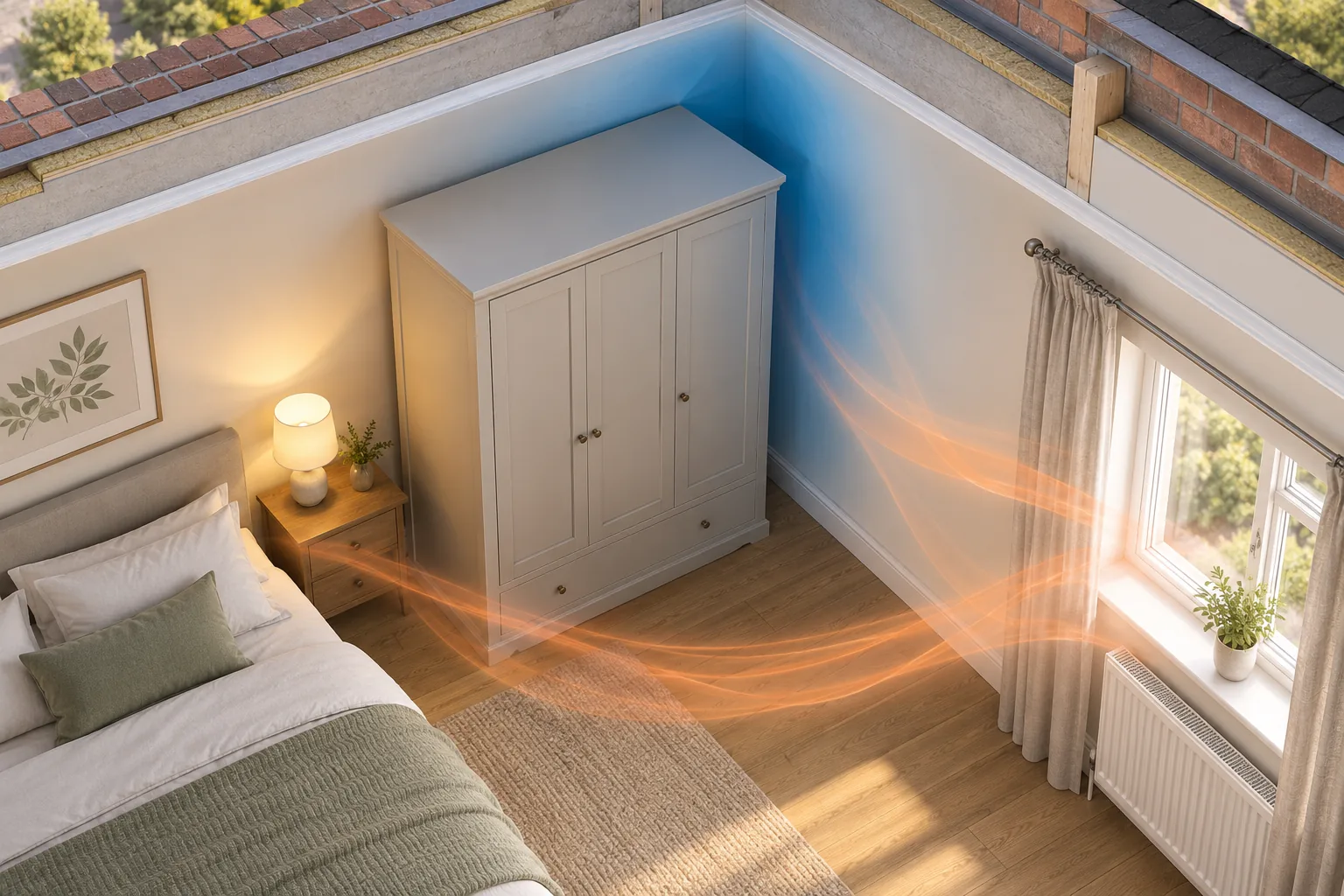
Warm room air does not circulate evenly. A wardrobe, headboard or heavy curtain can leave a pocket of cooler, still air against the wall. The surface can stay colder because room heat does not reach it well. Water vapour can then condense there while the visible, open wall remains dry. Oxford City Council’s condensation guidance notes that cold surfaces and restricted circulation, including behind furniture, are common conditions for condensation and mould.
Measure the gap between furniture and the wall and photograph the layout before changing it. A few centimetres of clearance may help air movement, but moving a large wardrobe is not always practical or safe. Do not strain or damage fittings to run an experiment. If the corner remains affected after furniture is moved or the airflow path improved, that is evidence worth recording, not a reason to blame the occupant.
Check whether the room door is often closed, whether vents are blocked and whether curtains cover a cold reveal. Ventilation needs a path for air to enter, move and leave. Opening a window briefly may change the room air, but it may not warm an uninsulated surface or repair a rainwater defect. An assessment should look at both the building detail and how the room is used.
Bedrooms gain moisture overnight
People add water vapour to indoor air through breathing. In a closed bedroom overnight, vapour can build up, especially if the room is small, several people sleep there or wet laundry is drying nearby. The room may also cool while heating is off. By morning, windows or a cold corner may collect moisture even if the wall looked dry the previous evening.
Observe the pattern without changing everything at once. Is there water on the window glass when the corner feels damp? Does the condition ease later in the day? Does it happen mainly in winter? A consistent morning pattern makes condensation more plausible. A stain that enlarges after heavy rain or an upstairs shower suggests another route may need investigation. Both can occur together.
Avoid turning the room very cold or sealing vents to test a theory. That can increase condensation and may make the bedroom uncomfortable or unhealthy. Record normal heating and ventilation, the number of occupants and whether laundry is dried indoors. If a room is difficult to heat, that constraint is part of the problem to report; advice should be realistic about costs and the building’s condition.
Check for an incoming water route
The same corner may sit below a gutter, beside an external crack or near a roof junction. From a safe position, note visible defects and whether the mark changes after rain. A stain that darkens after wind-driven rain on that face deserves a closer external check. A concealed pipe route may matter if a bathroom or heating system is nearby.
Do not choose between “condensation” and “leak” solely by looking at mould colour. Mould can grow where a surface remains damp for several reasons. A roof defect can make the corner cooler and wetter, which may increase surface condensation as well. A damp inspection should compare weather, room conditions, construction and accessible exterior details. GOV.UK guidance on damp and mould stresses identifying and addressing the source rather than relying on a surface clean.
If the corner is at floor level, look at skirting and flooring too. If it is high near a roof edge, inspect the building route above. Position narrows the questions but does not confirm a mechanism. Keep the evidence factual: “mould returned in the north-east corner after three cold nights” is more helpful than “the landlord’s roof is leaking” without further proof.
Gather a short comparison record
Take a wide photograph of the bedroom, a medium view showing furniture and a close view of the affected corner. Date them. Note heating periods, whether vents and windows were open, any water on the glass, recent rain and whether the patch or mould changed. A low-cost humidity monitor can show a trend if it is used consistently, but one display is not a definitive diagnosis.
Compare similar corners. Does the other external corner in the bedroom behave the same way? Are there spots behind furniture in another room? If only one corner is affected, look more closely at its construction and outside exposure. If several cold surfaces are affected, room-wide humidity and ventilation may be important. A professional may record surface temperatures and airflow as well as moisture signs.
Do not delay prompt mould attention simply to build a perfect log. If the affected area is spreading, the surface is deteriorating or someone cannot use the room normally, report it and seek an assessment. Keep photographs before safe cleaning where practical so the location remains clear to the inspector.
Match the remedy to the cause
If surface condensation is the main issue, the response may involve improving moisture removal, ensuring existing ventilation works, addressing cold building details and adjusting furniture placement where feasible. A working bathroom or kitchen extractor can reduce vapour reaching the bedroom, but its effectiveness depends on an airflow path. A surface clean alone may leave the corner vulnerable if it stays cold and damp.
If rainwater or plumbing is involved, the source must be repaired before decorating the corner. A new thermal lining applied over an active leak could hide deterioration. Conversely, repeated exterior sealing will not solve a cold, unventilated pocket behind a wardrobe. The report should connect each recommendation to the observed pattern and explain any uncertainty.
An assessment of condensation and ventilation can compare the corner with the rest of the room and check how air moves. For a London bedroom with repeated local mould, contact our team with dated photographs, room layout and the conditions when the problem returns. That allows the next step to address the specific corner rather than applying a generic mould remedy.