
Bathroom Extractor Running but Moisture Lingering

The bathroom fan makes a familiar sound, but the mirror stays wet and the ceiling remains clammy long after a shower. A running motor shows that something is powered; it does not establish that enough moist air is leaving the room. The fan may be obstructed, poorly connected to its duct, switched off too soon or lacking a route for replacement air to enter. A cold surface or an unrelated leak may add to the problem.
Start by observing the room during normal use. How long does visible condensation remain? Where does it form first? Does the fan start with the light, respond to humidity or run continuously at a lower speed? Is the door usually closed? These details help a ventilation specialist distinguish a control problem from an airflow problem. Do not dismantle electrical equipment or climb to inspect a duct yourself.
A motor sound is not an airflow measurement
A fan can spin while moving little air. Dust at the grille, a stuck backdraught shutter, a crushed flexible duct or a long, twisting route can reduce flow. A fan installed far from the shower or behind a partition may also collect humid air less effectively than expected. The grille’s appearance may be misleading: a clean face can hide a blocked route.
From a safe position, look for obvious dirt, a loose cover or a fan that changes pitch unusually. Note whether the grille draws air when the fan is on. A light tissue held near, without pushing it into the grille, can show some air movement, but it cannot quantify performance or prove the system meets a requirement. A competent person can measure airflow with suitable equipment and inspect accessible ducting and the external outlet.
The relevant standard depends on the dwelling and the building work carried out. The current GOV.UK Approved Document F guidance sets out ventilation guidance for dwellings, including extract systems, but a homeowner should not infer compliance from a fan label or a phone app. Ask an installer or assessor what system is present and how it was tested.
Moist air needs a path out and replacement air in
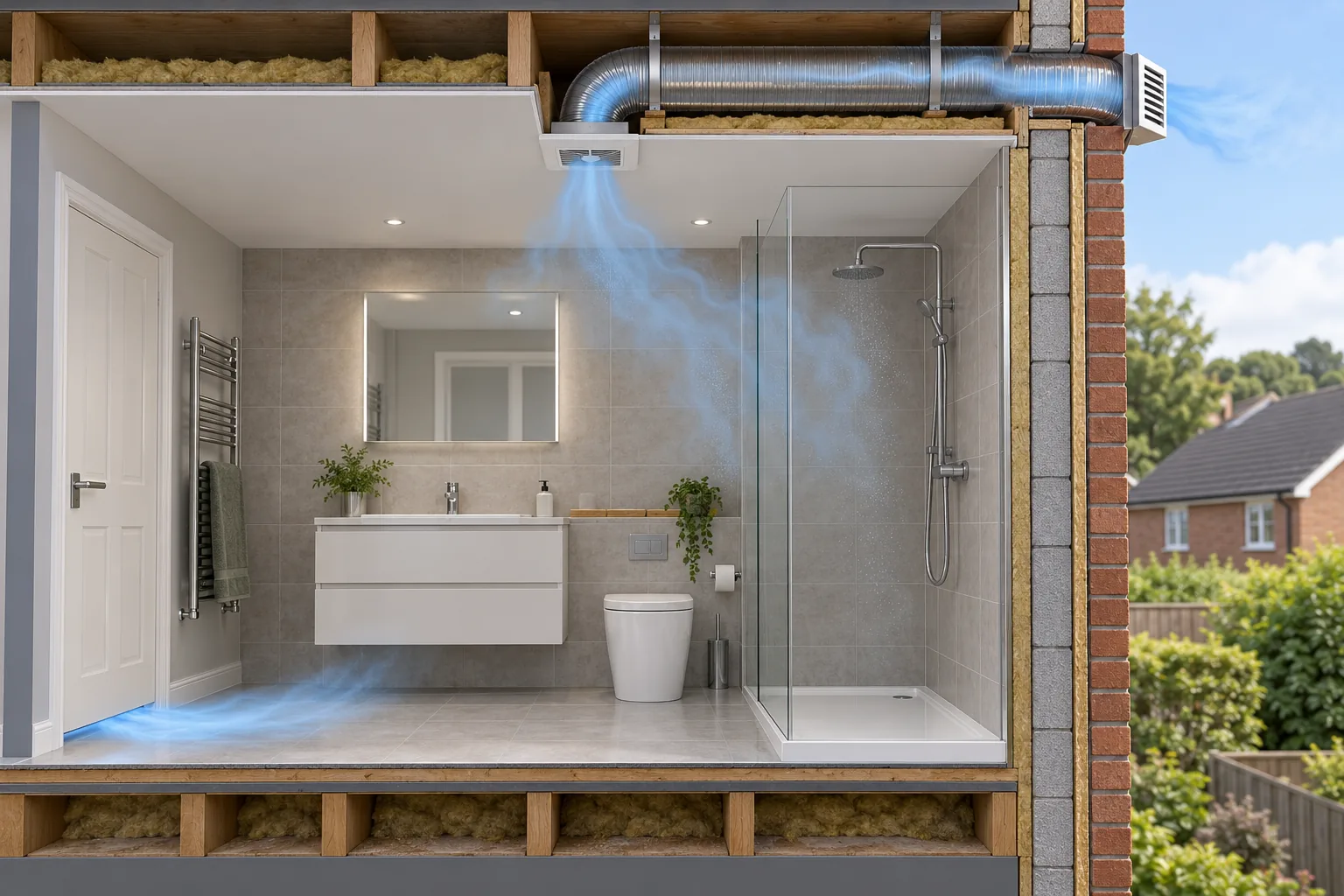
An extractor removes air from the room. For that to continue, replacement air must be able to reach the bathroom. If the door fits tightly to the floor and no transfer route exists, the fan may struggle even while spinning. Closing a window or blocking a background vent can also change the air path elsewhere in the home. In a flat, a shared or central system may behave differently from a simple fan through an outside wall.
Observe whether the door is open or shut during bathing and after. If the fan seems to work better with the door slightly ajar, that is a clue about the transfer path, not a permanent instruction to leave the door open. Steam should not simply be pushed into a bedroom or corridor. A ventilation assessment can consider the whole route from fresh-air entry to wet-room extraction and outside discharge.
Do not seal gaps, cover grilles or alter controls to suppress noise without knowing their purpose. A quieter room with less airflow may develop more persistent moisture. If a fan is noisy or draughty, report that as a performance issue so the system can be checked rather than disabled.
Check how the fan is controlled
Some fans run only with the light; others have a timer, humidity control or continuous low-speed mode with a boost. If the light is switched off immediately after a shower and the fan stops at the same moment, moisture generated during bathing may remain. A timer set too short or a sensor placed where it does not see the humid air can have a similar effect. A fan that never stops may instead be a continuous system functioning as designed, not necessarily a fault.
Write down the actual sequence: starts when, runs for how long, changes speed when, and stops when. Compare a normal shower with a quiet period when the bathroom is unused. If an automatic control seems erratic, do not adjust wiring or open the casing. The manufacturer or a qualified installer can check controls safely.
The goal is not to chase perfectly dry mirrors within seconds. Surfaces and room size affect how long droplets remain. Persistent wetting of the ceiling, walls or adjacent room is more concerning, especially if mould or paint damage follows. Record the time until visible water clears under similar conditions rather than relying on a single bad day.
Confirm where the duct ends
The fan should remove moist air to an appropriate external outlet. A disconnected duct in a loft or ceiling void can deposit moisture into hidden fabric while the bathroom fan sounds normal. A blocked terminal can also reduce flow. Look from a safe accessible position for an outlet where one is expected, but do not climb onto a roof or open a sealed void to search for it.
If a new bathroom or roof alteration preceded the problem, keep the drawings or installer paperwork. Ask where the duct runs, whether it is insulated where necessary and where it terminates. Flexible duct crushed above a ceiling can be hard to see from the room. A qualified inspection may need access through an existing hatch or a targeted opening.
In a converted London flat, the route may pass through shared fabric or a building-wide ventilation system. The managing agent may need to provide access and information. Do not assume the small grille on the outside wall belongs to your bathroom without checking its route.
Consider the room’s cold surfaces and other moisture sources
Even a functioning fan cannot instantly warm a cold ceiling or remove water already condensed on tile and glass. A cold external wall, poor insulation, a deep window reveal or an unheated bathroom can make surface condensation more likely. Note whether the wetness is concentrated on one cold surface or widespread. If the mirror clears but one ceiling corner remains damp, inspect that corner’s construction and any roof or plumbing route above it.
Leaks can mimic or compound condensation. A stain that grows after rain, water use above or a plumbing cycle may need a different investigation. Do not assign every bathroom mould patch to “steam” because there is a shower in the room. GOV.UK damp and mould guidance stresses identifying and addressing the underlying moisture cause.
Normal habits matter, but advice must fit the actual building. Covering the bath or wiping surfaces can reduce residual water, yet it cannot repair a disconnected duct. A functioning extractor cannot fully compensate for a persistent pipe leak. The best recommendation follows measured performance and the observed pattern.
Make a useful record before the appointment
Photograph the fan grille, visible outlet if safely accessible, wet surfaces and any mould or paint damage. Record when condensation appears and how long it lingers after normal bathing. Note the fan’s control behaviour, door position and whether a window or vent was open. If the problem began after an installation or refurbishment, include that date.
Do not use a single humidity reading as a pass or fail test. A small monitor can show whether humidity rises and falls, but its placement and the room’s temperature matter. An assessor can use the timeline alongside airflow measurements and a check of the duct route. If mould is present, arrange prompt appropriate attention while the cause is investigated.
An assessment of condensation and ventilation should explain whether the fan extracts adequately, whether air can reach it and whether the discharge route is sound. If the fan runs but your London bathroom stays persistently wet, contact our team with the control pattern and photographs. That gives the visit a clear starting question beyond “the fan is on”.